Table of Contents
Goshenite: The Purest Form of Beryl, Explained
Hold a well-cut goshenite up to a winter window and it seems to gather every bit of light in the room. This gem is the colorless variety of beryl, the same mineral family that gives us emerald, aquamarine, and morganite. With almost nothing to tint it, the stone shows beryl in its clearest form, and its clean, glassy brilliance suits both everyday wear and modern design.
Because it is less familiar than its colorful relatives, it raises good questions. What gives it such clarity? Where does it come from? Is it durable enough for a ring? Below, we answer each one, then share the story of a small parcel of Maine goshenite that became the heart of our Winter Solstice collection.
What Is Goshenite?
Goshenite is a gem-quality, colorless beryl. Beryl is a beryllium aluminum silicate that forms six-sided crystals, most often in granite pegmatites. When it grows with almost no coloring trace elements, the result is a clear gem with a bright, glassy luster and a hardness that holds up well to everyday wear.
The name comes from Goshen, Massachusetts, where the stone was first described. That New England origin makes it a natural fit for a jeweler rooted in Maine.
Clear beryl also has a long history in optics. Polished beryl was used in early lenses, and the German word for eyeglasses, Brille, is often traced back to beryl.
Where Goshenite Fits in the Beryl Family
| Beryl variety | Color | What creates the color |
|---|---|---|
| Emerald | Green | Chromium or vanadium |
| Aquamarine | Blue to greenish blue | Iron |
| Morganite | Pink to peach | Manganese |
| Heliodor | Yellow to greenish yellow | Iron |
| Red beryl | Red | Manganese |
| Goshenite | Colorless | Little to no trace elements |
Why Is Goshenite Colorless?
Its crystal structure holds very few of the trace elements that tint other beryls. A small amount of chromium turns beryl into emerald. Iron brings out the blues of aquamarine. Manganese creates the soft pink of morganite. This variety carries so little of these elements that light passes through almost untouched, which is how it earned its reputation as the purest form of beryl.
That purity is a matter of degree. Many of these stones hold faint whispers of color that only appear in certain light or after thoughtful cutting. A skilled cutter can coax those hints forward, as you will see in the Maine stones below.
Properties at a Glance
| Property | Detail |
|---|---|
| Mineral family | Beryl |
| Chemical formula | Be3Al2Si6O18 |
| Hardness (Mohs) | 7.5 to 8 |
| Refractive index | About 1.57 to 1.60 |
| Crystal system | Hexagonal |
| Luster | Vitreous (glassy) |
| Typical clarity | Often eye-clean |
| Notable sources | Brazil, Pakistan, Madagascar, Namibia, Russia, and the United States |
With a Mohs hardness of 7.5 to 8, the stone is harder than quartz and well suited to rings, earrings, and pendants worn often. Like all beryl, it can chip from a sharp blow, so a protective setting is a smart choice for a ring you plan to wear every day.
Is Goshenite Rare?
Colorless beryl is fairly common as a mineral and generally more accessible than fine emerald or aquamarine. Clean, well-cut gem material in jewelry sizes is harder to find, and a stone with a specific origin and a distinctive character is rarer still. Clarity, cut quality, size, and origin shape its value far more than color does.
How to Tell It Apart From Look-Alikes
Colorless quartz, topaz, white sapphire, glass, and synthetic stones can all resemble this gem at first glance. A trained gemologist separates them with standard tests, including refractive index, specific gravity, and magnification.
When shopping for goshenite jewelry, ask about the stone's identity and origin, and buy from a jeweler with gemological expertise on staff. Our team includes a GIA-certified appraiser who can answer questions about any colored gemstone. Learn about our appraisal services.
Maine Goshenite: A Winter Light From Home
Maine has a remarkable gemstone heritage, and we are always looking for Maine stones to share with our customers. This parcel gave us a rare chance to do exactly that.
How this Parcel Found Us
The story began when one of our trusted gemstone suppliers approached Julie Collins, VP of Merchandising with a unique opportunity: a parcel of 14 cut and faceted Maine Goshenite stones, including two matched pairs from the Emmon Quarry in Greenwood, Maine.
We bought every stone for two reasons. Each one was different, and every one came from Maine. In her years of buying colored gemstones, Julie has never been offered another parcel like it.
What Makes Maine Goshenite Different
Goshenite from many parts of the world is almost perfectly clear, but the Maine gem can hold a little more. Depending on how it is cut, it can reveal a light, luminous tinge of blue. Each stone was oriented and faceted to draw out the very best of that color.
Maine is also a source of aquamarine, another member of the beryl family, often found in shades of light sky-blue to pale blue-green. The stones in our parcel show a pale, icy blue that feels true to a Maine winter.
Designed Around Each Stone
In the spring, Julie presented the parcel to Cate, Assistant Buyer. Cate has a gift for sketching, and the goal was simple: let her build a collection and a story around these 14 stones.
Each piece followed the same path:
- Cate sketched a design for a specific stone.
- One of our manufacturing partners created a CAD model from her drawing.
- Our team reviewed the model and refined the details.
- We sent the stones to the manufacturer, who built each setting around its stone.
That last step matters most. Every colored gemstone has its own proportions, so each mounting was shaped to fit its stone and show it at its best.
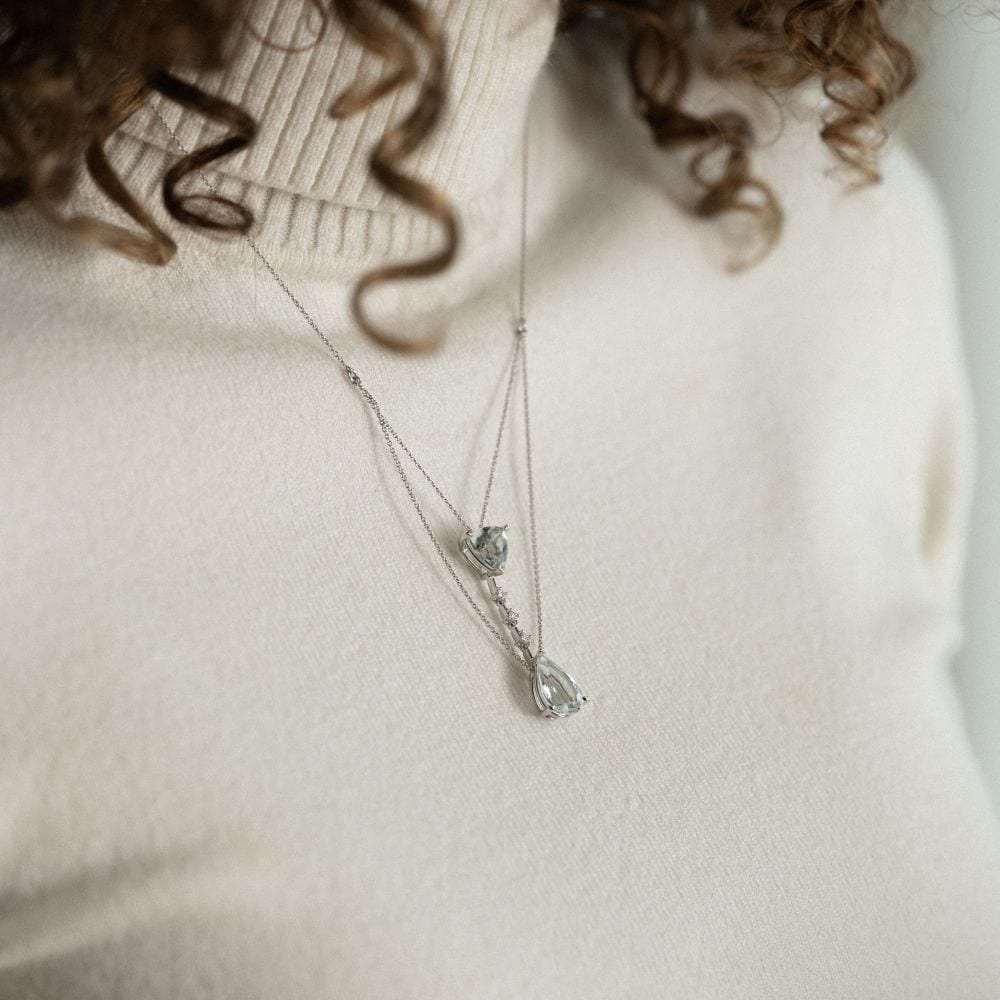
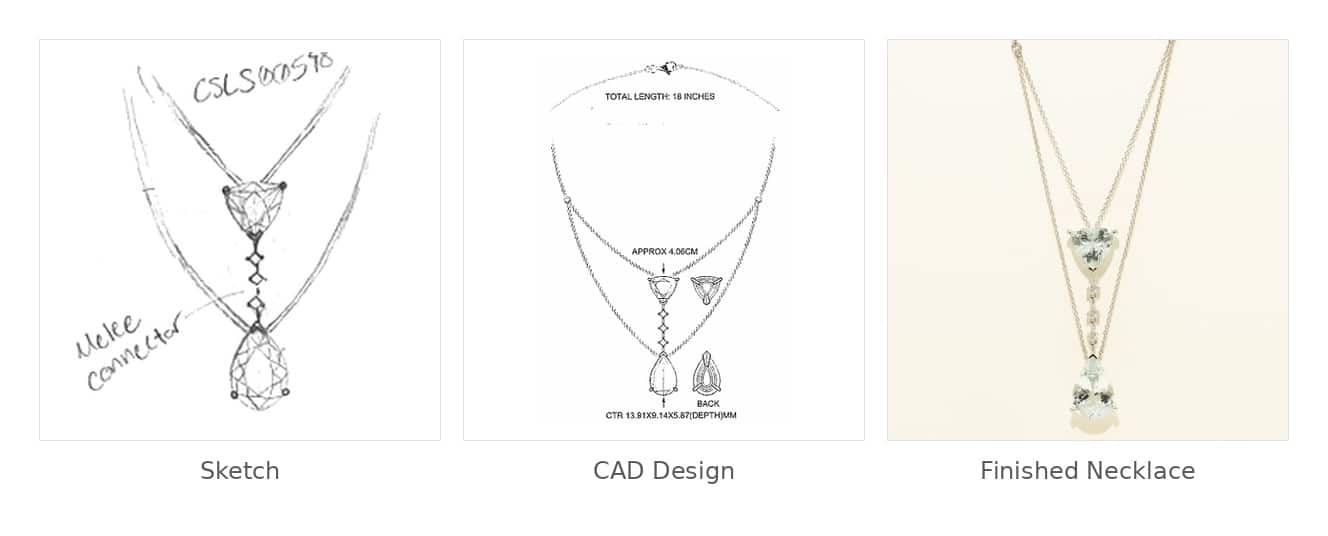 From sketch to finished necklace
“Each piece is designed around the specific stone. Each individual colored gemstone has its own unique properties and unique dimensions, and so designing around that stone is really important to optimize the stone itself.”
— Julie Collins, VP of MerchandisingThis reflects how we buy color at Day’s Jewelers. We choose individual stones we fall in love with, and we often wait to design until a stone inspires us. As Julie puts it, “The design is really inspired by the stone itself and usually not the other way around.”
Cate found that each stone presented its own puzzle. Even stones that appeared similar in shape could differ in their cut, depth, and faceting, requiring careful consideration to determine the setting that would best complement each individual stone.
The Winter Solstice Collection
The finished pieces form Winter Solstice, our holiday collection. Winter themes often lean on whimsical snowflakes, but Cate wanted a broader, more subtle approach. She drew inspiration from the winter sky and how clear the stars are this time of year, with abstract nods to icicles and snowflakes. The result is a collection that feels wearable long after the holidays.
Her favorite designs include a pear-shaped goshenite framed by a pavé half-moon and flutter pendants that move gently as you wear them. With only 14 stones in the parcel, every piece is one of a kind.
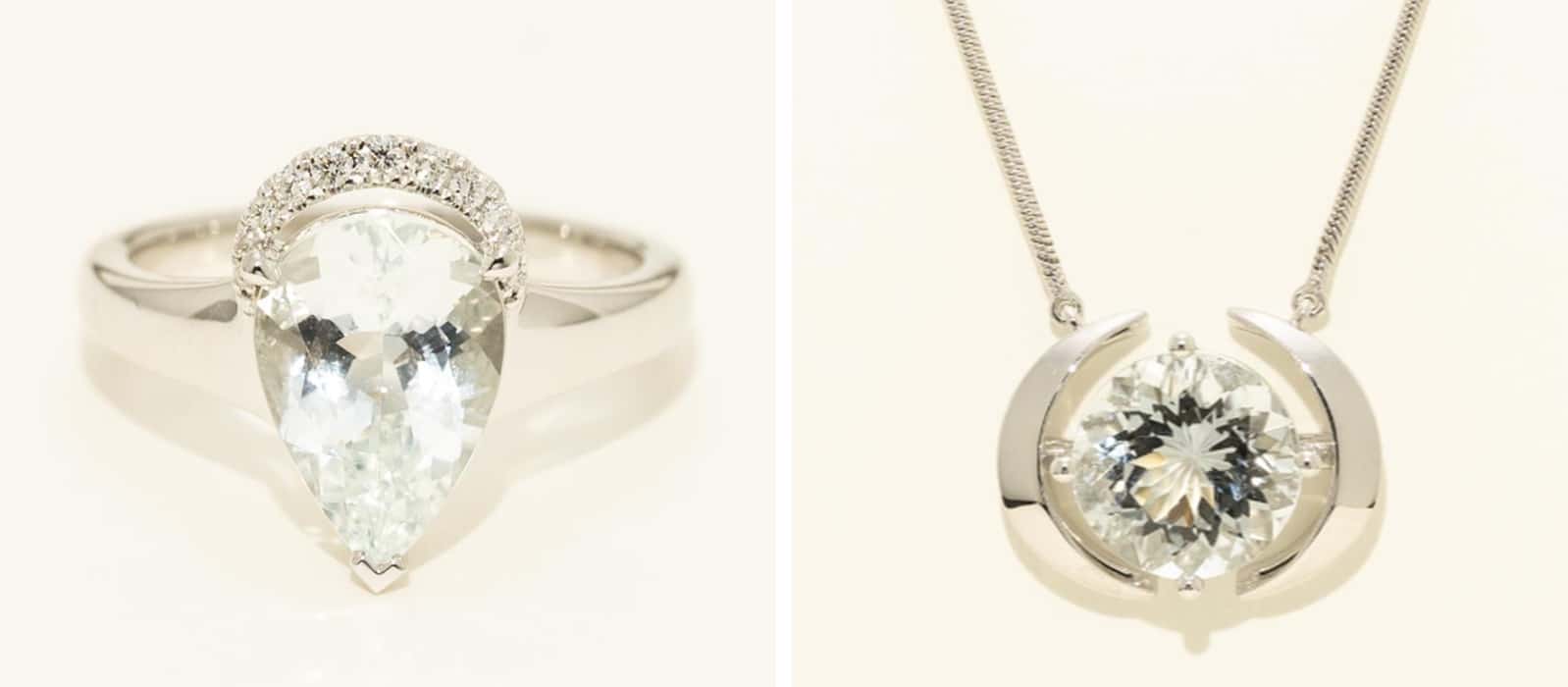 Two of Cate’s favorite Winter Solstice designs
"It is from Maine, and it symbolizes the Maine winter, the longest season of the year."— Cate, Assistant BuyerExplore the Winter Solstice collection
How to Care for Goshenite Jewelry
This gem is durable and easy to care for. A few simple habits will keep it bright:
- Clean gently. Soak the piece in warm water with a drop of mild dish soap, then brush behind the stone with a soft toothbrush. Rinse and dry with a lint-free cloth.
- Avoid harsh chemicals. Remove your jewelry before using household cleaners, chlorine, or hairspray.
- Store it separately. Diamonds and sapphires are harder and can scratch it, so keep each piece in its own soft pouch or lined compartment.
- Protect it from hard knocks. Take off rings before gardening, lifting, or working with your hands.
- Schedule regular inspections. Have your fine jewelry checked regularly to confirm prongs and settings are secure. See our jewelry care and inspection services.
A Gem Worth Knowing
This stone offers the hardness and heritage of the beryl family in its clearest form. It is a gem with New England roots, a quiet brilliance, and the ability to surprise you in the right light.
Our Maine goshenite carries that story a little further. Fourteen stones, cut to reveal a soft winter blue and set into designs made for each one, now make up a collection that exists nowhere else.
Visit your nearest Day's Jewelers location to see the Winter Solstice collection in person, or explore it online. Our sales team members are happy to help you find the piece that speaks to you.